

This week’s article is written by Dr. Stephen Hussey, a chiropractor, functional medicine practitioner, author, and health educator specializing in heart health, metabolic health, and environmental health. Drawing on both his clinical experience and his own personal journey with heart disease, Dr. Hussey has dedicated his work to exploring the underlying causes of chronic disease and helping people better understand how lifestyle, light exposure, circadian biology, and environmental factors influence long-term health. In this first installment of a two-part series, he offers a different perspective on artery plaque and challenges readers to think beyond the traditional conversation surrounding cholesterol.
Science is about asking questions. When trying to find the answer to what leads to plaque that develops in our arteries, the conversation often revolves around cholesterol and diet. People often ask the question: does cholesterol/LDL cause atherosclerosis? If we just look at the research there is a lot of evidence suggesting that the answer to that question is a simple no. (R) That is all well and good, but after reading this short article, you will see why this is the wrong question, and even if we have an answer to it, it doesn’t help us understand what actually causes artery plaque.
Instead of asking if cholesterol/LDL causes artery plaque, which significantly narrows the focus, we should be asking what causes artery plaque, which creates a much broader focus. The reason we need a broader focus is because there are many things that have been associated with higher amounts of artery plaque. These include insulin resistance (R), exposure to artificial light at night (R), toxin exposures like microplastics (R) and heavy metals (R), inflammation (R), disrupted circadian rhythm (R), less than optimal blood flow dynamics (R), and lack of sunlight exposure (R).
Any theory of heart disease that cannot account for all the things listed above (ahem, the cholesterol theory) has to be wrong, or at the very least, incomplete. To start to develop a better, more complete theory, let’s ask some better questions.
What is artery plaque?
The mainstream thinking is that plaque is made up of cholesterol. However, research has shown that plaque is largely made up of fibrotic clotting tissue. (R) The mainstream argues against this saying that cholesterol starts the process and clotting tissue comes later, but research shows that clotting tissue is present through the entire process (R) and that clotting factors modulate the beginnings of artery plaque development. (R)
Where is artery plaque?
When most people envision plaque in an artery, they see it as something that forms on the inner lining of the artery wall, like this:
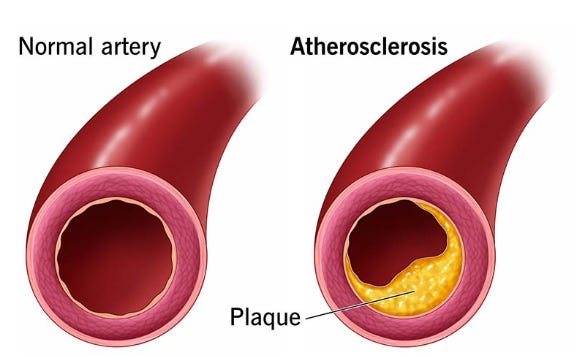
But depictions of plaque this way are inaccurate. The picture below is an image that was created using Cleerly, an AI imaging technique, by using the raw data from a Coronary Computed Tomography Angiogram (CCTA) test.
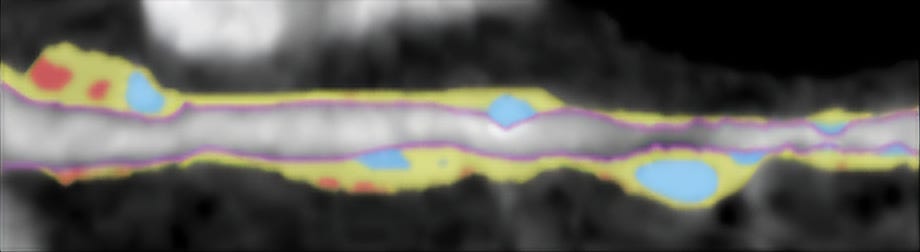
As you can see, the plaque forms in the artery wall, making the artery wall expand into the middle of the artery as well as externally away from the middle of the artery.
As we discussed, research has shown that plaque is primarily made up of clotting tissue. Clotting is something that happens in blood. So how does clotting tissue end up inside the artery wall when the blood is inside the tube that is the artery?
Well, the walls of the blood vessels are made up of cells that also need a blood supply to get oxygen and nutrients. This blood does not come from the blood flowing in the artery, it comes from small blood vessels called the vasa vasorum.
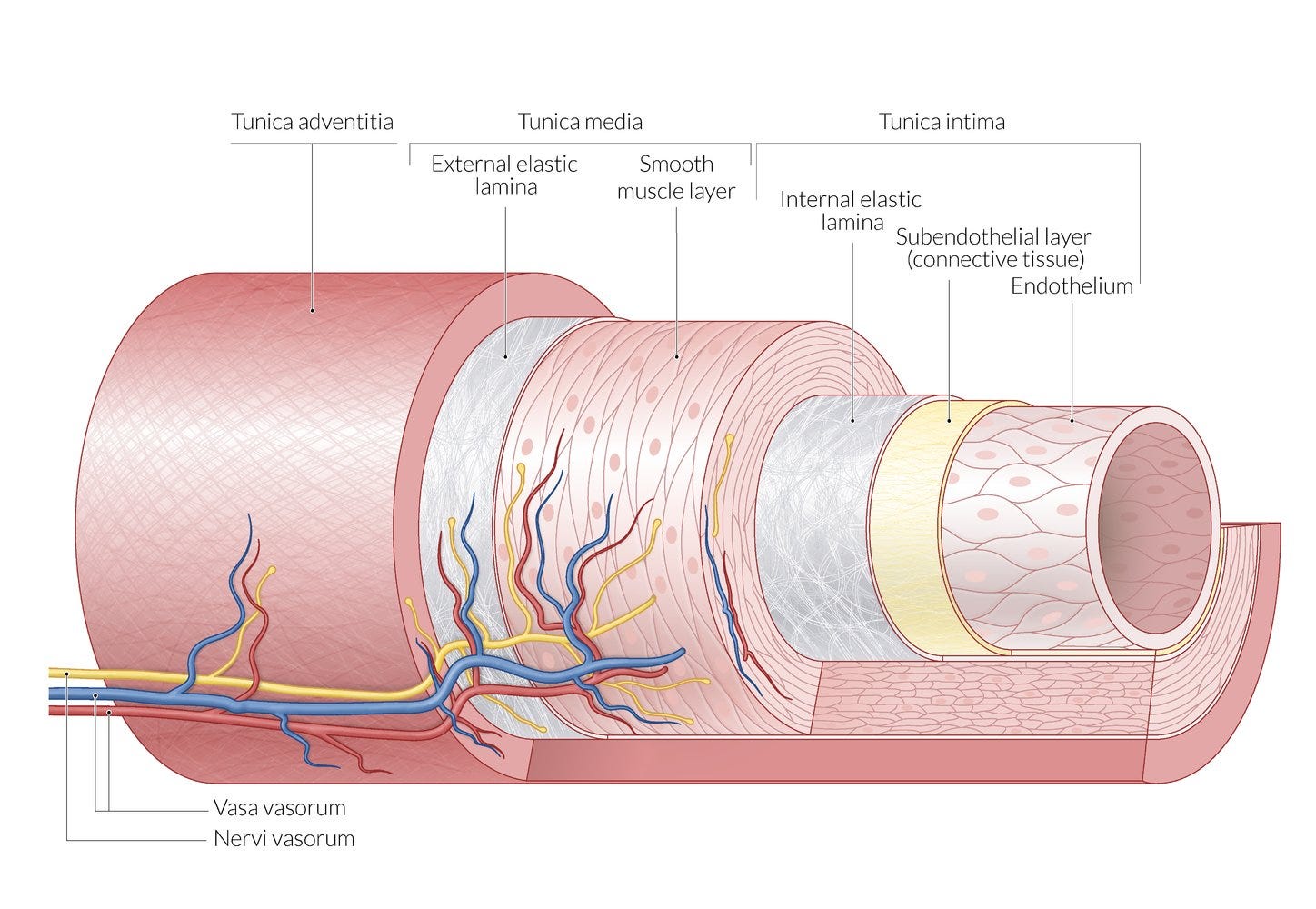
This works quite well as long as the inner lining of cells in the artery (endothelia) are healthy and of normal thickness (a), but if the endothelia start to proliferate, or grow (b), it can start to cause issues.
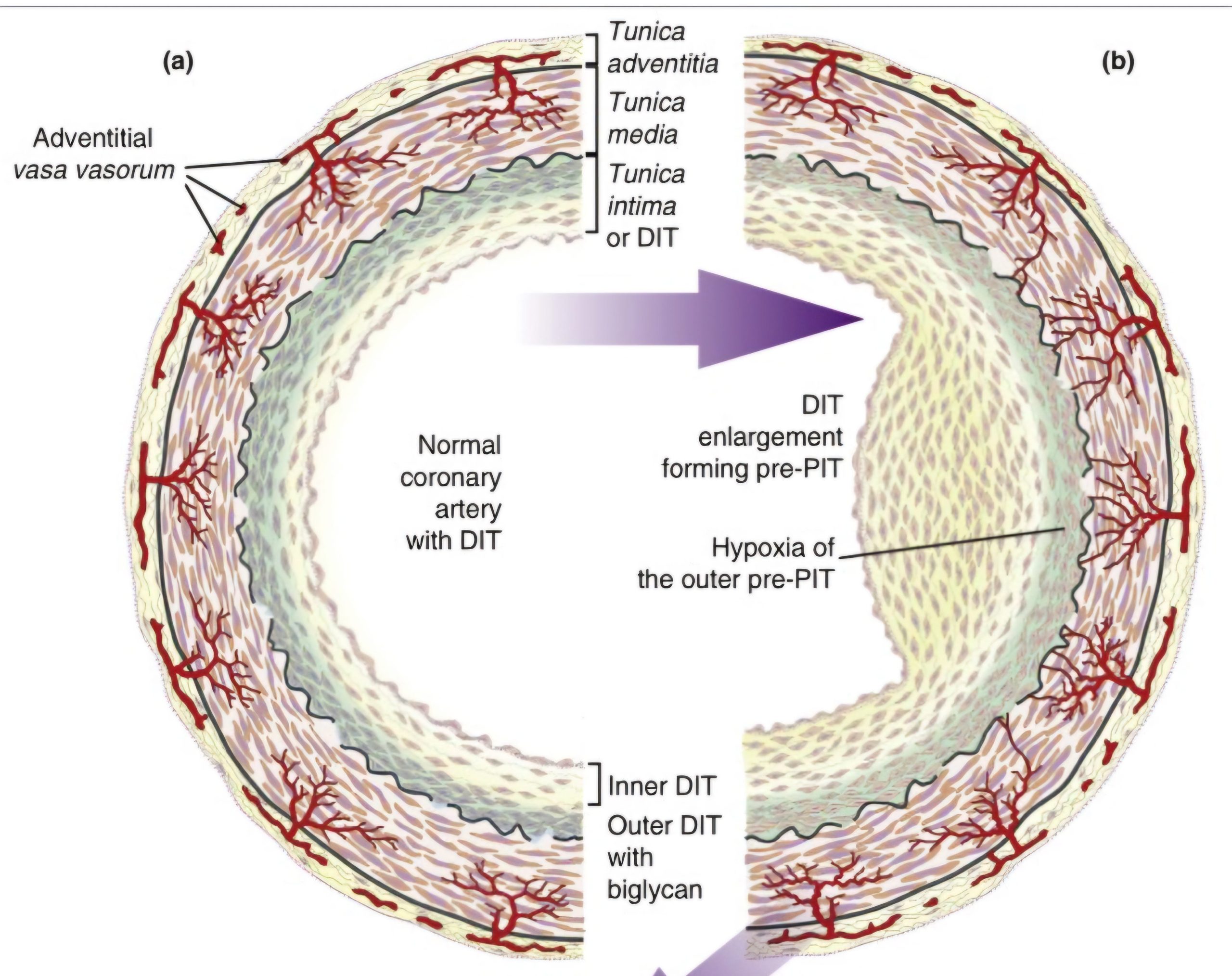
If the endothelial layer starts to get thicker, the new cells need a blood supply to them as well. In this situation, the vasa vasorum starts to grow new blood vessels into the intima layer of the artery wall (c). The issue with this is that as new blood vessels form, there is a period of time when they are incomplete, kind of like when you are building a house and there is a period of time when it has no windows or doors yet. This allows blood to leak out of these newly forming arteries. It leaks right into the intima layer (d). (R)
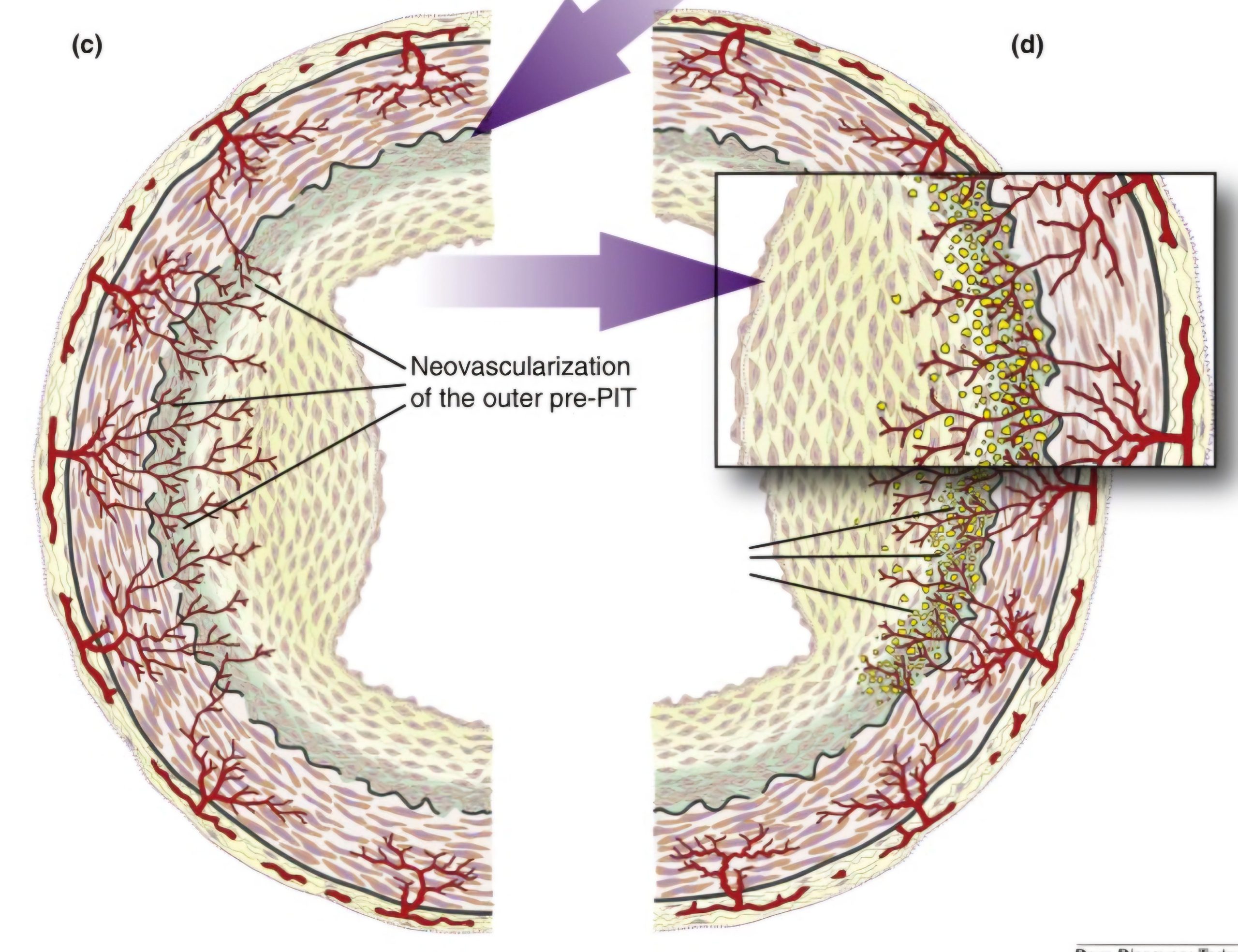
This creates a situation where blood is not in the tube of the blood vessel and therefore not flowing well or at all. Stagnant blood clots, and in this case, it clots in the intima layer of the artery wall. This is exactly where we see atherosclerosis in the Cleerly image above.
As long as the inner layer of the artery keeps multiplying and getting thicker, the vasa vasorum keeps making new arteries, blood leaks and becomes stagnant, and clotting tissue continues to build in the artery wall. Cholesterol can be present in small amounts in plaque, but only because LDL molecules that carry cholesterol are in the blood, and therefore they are also leaking out of the newly forming blood vessels. So, LDL/cholesterol isn’t a cause of plaque, it just gets caught up in the clotting in the intima wall when this situation happens. This process can eventually encroach on the middle of the artery and alter blood flow.
From here, the theory is that artery wall plaque can rupture into the middle of the artery, cause a clotting response, block the artery, and cause a heart attack. However, research has shown that while plaque ruptures do happen and contribute to further narrowing of an artery and sometimes cause heart attacks, they are not the cause of heart attacks as often as we think. (R)
The main reason that having plaque in arteries is associated with a higher risk of having a heart attack (R) is not because of plaque ruptures, but because encroachment into the middle of the artery by plaque alters blood flow dynamics and altered blood flow significantly increases the risk of a clotting response in blood (R), especially in the tight spaces created by plaque.
So, the real question we need to ask in order to find the cause of artery plaque is what initiates the proliferation of the endothelial cells and starts this whole process in the first place. Understanding this will show us how to prevent it.
The main cause is direct damage to the lining of the artery wall. Damage creates a healing response that includes proliferation of the endothelial cells. (R) There are many things that have been shown to damage the artery wall; heavy metal exposure, microplastic exposure, herbicide and pesticide exposure, fluctuating blood sugars, endotoxins, oxidized fats, etc.
Secondarily, it has also been shown that less than adequate blood flow can induce a thickening of the endothelial layer due to a lack of lateral pressure on the artery wall. (R,R)
So how do we prevent these two things? Well, scientists have found that a gel-like layer of water forms on the lining of the artery wall, labeled EZ in the image below. (R) This gel-like layer protects the lining of the artery from toxins and elements of blood because almost nothing can penetrate through it once it has formed. (R) The gel-like water has also been shown to create blood flow (R), which keeps blood moving to maintain lateral pressure.
This means that the best way to prevent proliferation of the endothelial lining is to maintain this gel-like water on the artery lining. Now, why does this make sense based on how the way of life for humans has changed in the last 100 years?
Well, it has been shown that the best way to build up the formation of the gel-like water is exposure to infrared light. (R) This makes sense because anytime the sun is up it is emitting 40-50% infrared light and all life on this planet is supposed to be outside in infrared light.
Considering that it has been estimated that people today spend an average of 93% of their time in environments void of infrared light (indoors or in an enclosed vehicle) (R), we are incredibly lacking in infrared light exposure, and it is likely contributing to our epidemic of heart disease. In fact, lack of sunlight has been linked to many chronic diseases, including heart disease. (R)
Our modern way of life can make it hard to get enough infrared light from the sun, especially in the winter in colder climates. Devices like infrared saunas and red/infrared light panels can be useful for boosting our infrared light exposure. Research has even shown that infrared sauna can help create health in the lining of the artery. (R)
My favorite sauna is the Relax Far Infrared sauna because it emits the most far infrared light, which is the best at building the gel water, of any sauna I know.
My favorite red/infrared light panel is from EMR-tek.
Let’s put this all together in a unifying theory of artery plaque. Over the last 100 years we have seen a dramatic rise in rates of artery plaque, especially in the United States. In that time, we have dramatically reduced our exposure to infrared light by spending more time indoors and by replacing fire and incandescent bulbs with fluorescent and LED bulbs. Without the gel-like water building up on our arteries to protect them and keep blood moving, it has left our arteries vulnerable.
In that vulnerable state, we have added numerous toxins into our lives from processed foods, plastics, heavy metals, herbicides and pesticides, air pollution, mold, endotoxemia from leaky gut and dental infections, etc. Without the gel-like layer of water for protection, these toxins can directly damage the artery wall.
Lastly, we have undermined the bodies’ ability to heal that damage once it happens. The two main ways our body heals are through signals of growth and repair from the hormone insulin and from having enough melatonin to get into deep reparative sleep every night. We have an epidemic of insulin resistance with it being estimated that 93% of the population has some level of poor metabolic health (R), and artificial light at night is leading to decreased melatonin levels and wrecking our sleep. (R)
The answer to preventing plaque in arteries is not obsessing over testing the state of things inside the blood and arteries, it’s about learning how our external environment has changed and how that is influencing our physiology in ways that force the body to create plaque in arteries.
So while the answer to preventing artery plaque is more complex than the cholesterol theory, it’s still simple. Get more infrared light and contact with the Earth to protect the arteries, avoid the toxins and non-native electromagnetic fields that damage the gel-like water and the arteries, and ensure you are insulin sensitive and getting enough deep reparative sleep by eating a whole foods, lower carbohydrate diet and syncing your body to the day night cycle of the sun.
The cholesterol focused approach to preventing heart disease needs to change, but as R. Buckminster Fuller said, “You never change things by resisting the existing reality. To change something, build a new model that makes the existing model obsolete.”
Stay healthy out there!
Dr. Stephen Hussey

Dr. Stephen Hussey
Dr. Stephen Hussey is a Chiropractor and Functional Medicine practitioner. His story of personally healing heart disease using light and environmental health strategies has become an inspiration to many and a calling for change in healthcare. In addition to Chiropractic clinical practice, Dr. Hussey is a health consultant, speaker, and the author of three books on health: The Health Evolution, Understanding the Heart, and Pain Sense. Dr. Hussey guides clients from around the world back-to-health in an online setting, using the latest research and health attaining strategies.