

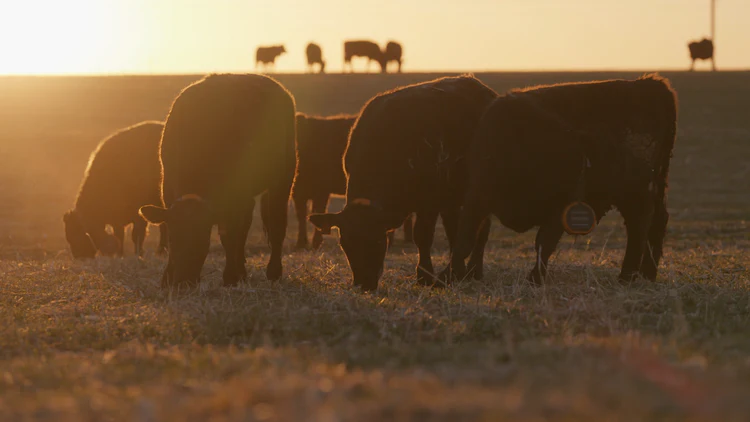
How Plainview Beef Is Rethinking Nutrient Density, Transparency, and the Future of Beef
Guest Contributor Series
This week’s Hack Your Health Journal article was written by Todd Edenborough, Co-Founder of Plainview Beef Co.
Todd and his business partner, Gabe Orr, founded Plainview Beef with a mission to challenge assumptions about food quality and rethink how beef is produced. Combining multi-generational ranching experience with a commitment to measurement, transparency, and continuous improvement, they developed what they call the Biohacked Bovine™ approach to beef production.
In this guest contributor article, Todd shares why he believes the future of healthier food depends not on labels alone, but on measurable outcomes that consumers can see, understand, and trust.
The following article is written by Todd Edenborough and reflects his experience, perspective, and opinions.
When people hear that I own a beef company, they usually assume it’s a ranching story.
In some ways, they’re right.
My business partner and co-founder, Gabe Orr, comes from a family that has been ranching for more than 100 years. His family’s experience raising cattle spans generations, and that heritage has been invaluable in building Plainview.
But Plainview was never intended to be simply another ranch.
We started this company because we felt called to help improve the part of the food system we know best: beef. And along the way, we found ourselves asking a question that ultimately changed everything:
What if the grass-fed versus grain-fed debate is missing the real issue?
Most consumers assume beef is beef.
Some might recognize differences between grass-fed and grain-fed. Others may pay attention to labels like organic, regenerative, pasture-raised, or natural.
While those labels can provide useful information, they don’t necessarily answer the question we believe matters most:
What is actually in the food?
At Plainview, we believe the future of healthier food isn’t built on assumptions. It’s built on measurement.
The reality is that not all beef is created equal, and most people don’t realize how significant that difference can be.
The nutritional quality of beef is influenced by countless variables, including:
- The animal’s diet
- Forage quality
- Soil conditions
- Environmental stressors
- Processing methods
- Aging practices
- Storage conditions
Yet much of the industry continues to rely on broad production categories rather than measuring actual outcomes.
The Biohacked Bovine™ Philosophy
In the health and wellness world, biohacking is often described as intentionally controlling the environment in and around you to take greater control of your health.
At Plainview, we simply applied that same philosophy to beef production.
What if we could control more of the nutritional environment surrounding the animal?
What if we could reduce unnecessary variables, measure the outcomes, and continuously optimize the system?
That’s what we call Biohacked Bovine™.
Not because we’re changing the animal, but because we’re intentionally optimizing the biological systems that influence the quality of the food it ultimately becomes.
Every decision we make is governed by a simple question:
Does this improve the nutritional quality of the final product reaching the consumer?
Rethinking Beef Production
We support grass-fed production. In fact, every animal we raise begins there.
But we’ve also learned that “grass-fed” is a feeding category—not a guarantee of nutritional consistency or nutrient density.
Agriculture is naturally variable:
- Rainfall
- Drought
- Extreme heat
- Snow
- Different soil conditions
- Different grass species
- Different stages of forage maturity
All of these factors influence what the animal consumes and ultimately the nutritional composition of the beef being produced.
That’s why we developed our proprietary sprout-finishing protocol.
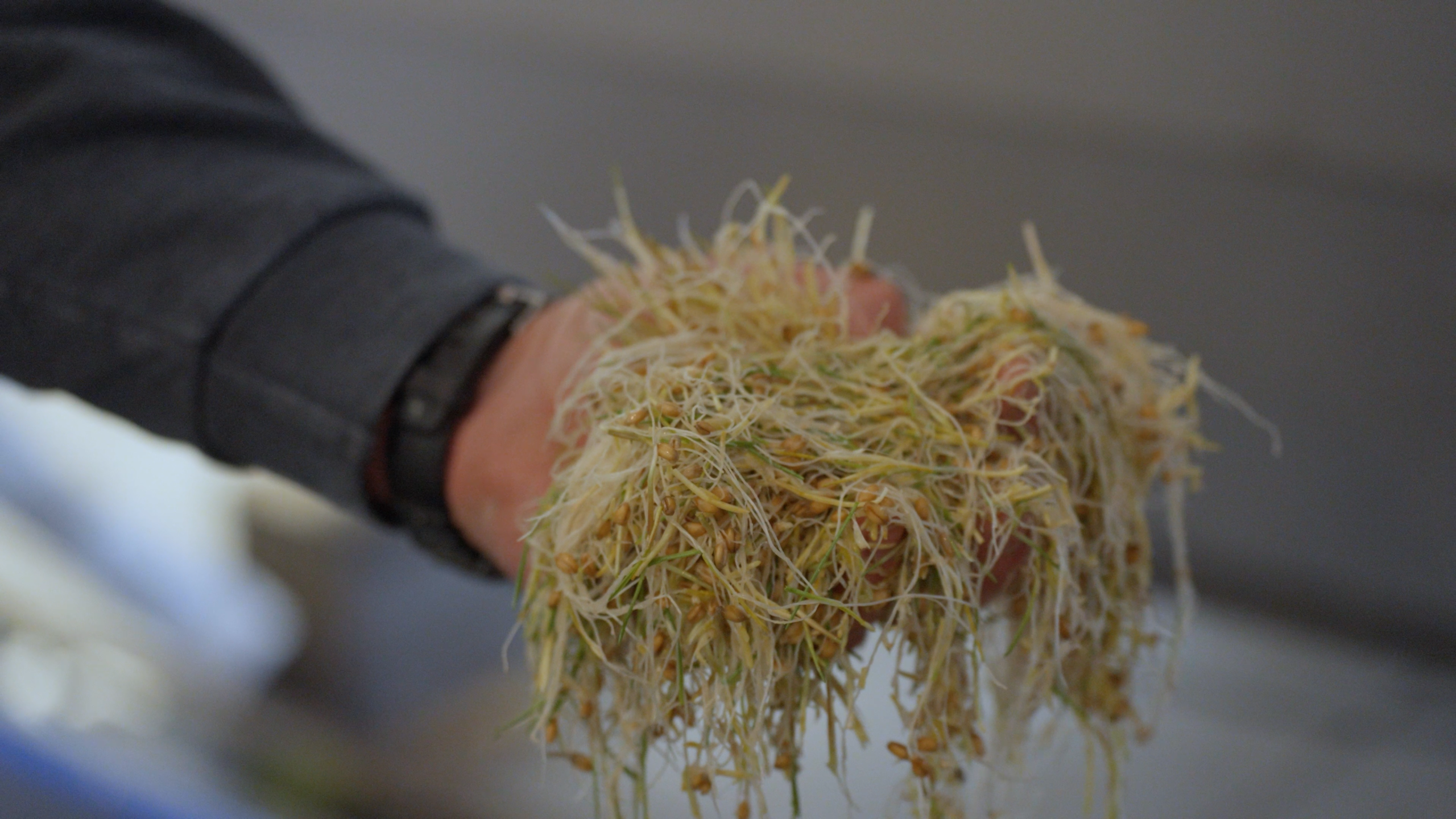
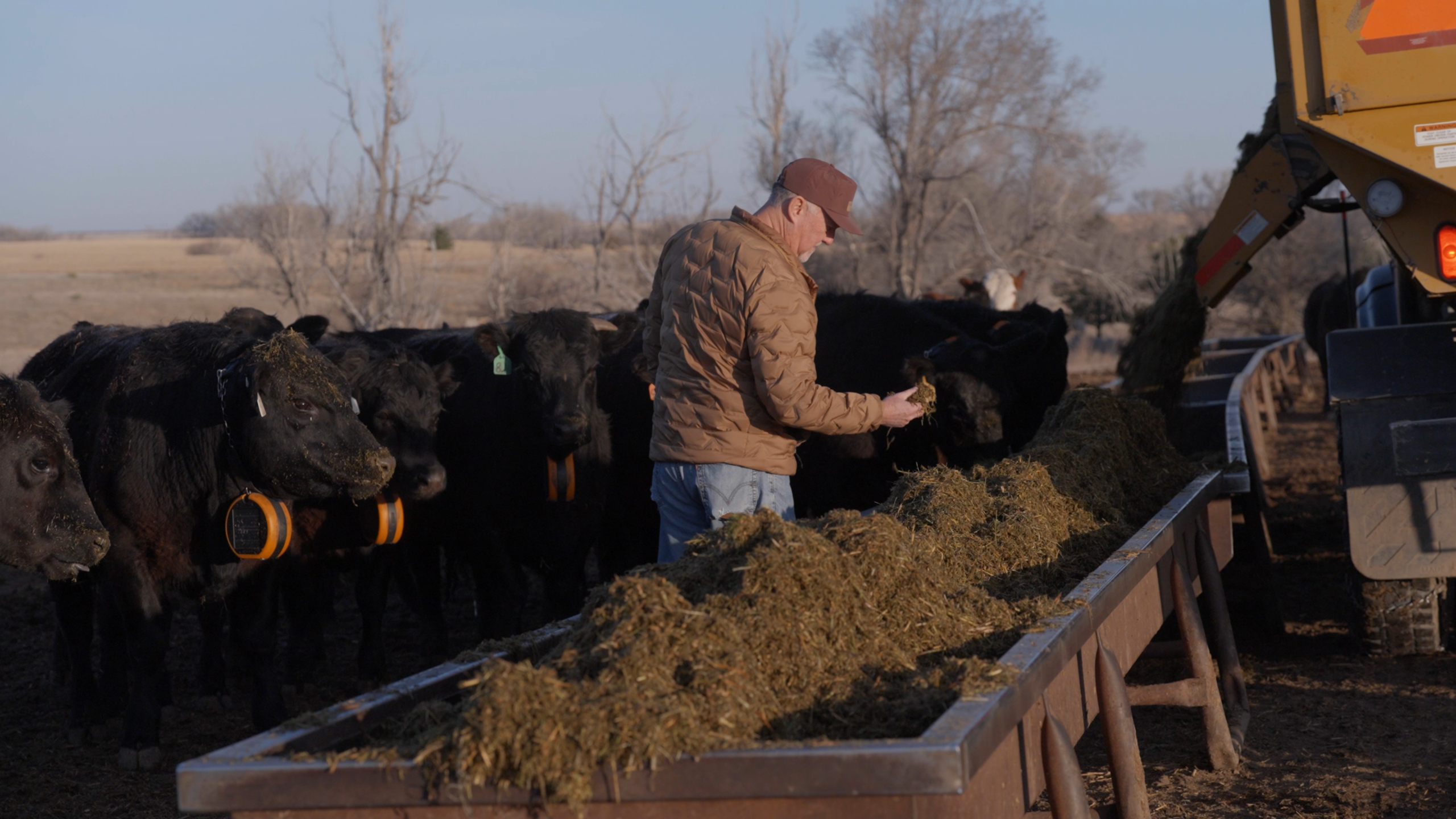
Rather than transitioning cattle into a conventional feedlot environment, our cattle remain on regenerative rotational grazing systems while receiving large quantities of fresh hydroponically grown wheatgrass sprouts harvested at peak nutrient density alongside custom fermented forage crops grown on-site.
This isn’t simply a supplement program.
It is the foundation of our finishing system.
A typical grass-fed animal may consume forage that varies dramatically throughout the year depending on uncontrollable conditions.
By growing fresh sprouts daily and producing our own custom silage blends on-site, we gain far greater control over the nutritional inputs entering the animal.
The system also allows us to support cattle performance without relying on a conventional feedlot.
While only a small percentage of U.S. cattle are finished entirely on grass, our protocol allows us to achieve finishing weights more commonly associated with feedlot production while maintaining pasture access and avoiding the need for grain-based finishing programs.
The result is a system designed to improve consistency, animal health, nutritional quality, flavor, tenderness, and scalability simultaneously.
Why Scalability Matters
One of the realities of modern beef production is that feedlots exist for a reason.
They provide consistency, predictable finishing weights, reliable supply, and scalability.
The challenge is that feedlots were largely designed to optimize efficiency and economics—not necessarily nutrient density or biological quality.
For decades, the industry has largely accepted a tradeoff:
You can have scalability, or you can have pasture-based production.
We weren’t convinced that tradeoff had to exist.
From the beginning, our goal wasn’t to create a boutique ranch producing a limited number of premium animals.
Our goal was to build a repeatable alternative to the conventional feedlot.
Healthy food systems don’t change the world if they only work at small scale.
To make a meaningful impact, they must be capable of producing consistent results year after year while remaining economically viable.
That’s one of the reasons we became obsessed with repeatability:
- The same finishing protocol
- The same sprout system
- The same measured outcomes
- The same transparency
We believe sustainability is ultimately about building systems that can continue producing high-quality food for future generations without sacrificing animal health, nutritional quality, or consumer trust.
Our vision has never been to create a better version of commodity beef.
Our vision is to help create an entirely new category of beef—one built around measurable nutritional outcomes rather than production labels alone.
Why Measurement Matters
One of the biggest differences between Plainview and many beef companies is our commitment to laboratory verification.
Rather than relying solely on production labels, we test both inputs and outputs.
As we’ve continued refining our system, we’ve seen measurable improvements in the nutritional composition of our beef.
The following results are based on Plainview Beef’s internal laboratory testing compared to grocery store beef:
- Omega-6 to omega-3 ratios improved from nearly 4:1 to approximately 1:1
- 154% more vitamin B12
- 102% more folate
- 120% more vitamin B5
- 240–267% more vitamin B1 and B2
- 26x more vitamin D
- 37% more iron and zinc
- Suppressed omega-6 levels and PUFA
The specific numbers matter.
But the larger principle matters even more.
We measure, adjust, and test again.
Most beef is assumed.
Ours is measured.
And we publish those results because we believe consumers deserve transparency about the food they’re feeding themselves and their families.
Quality Control Doesn’t End at the Ranch
As we continued building Plainview, we discovered another major quality-control gap in the beef industry:
Processing.
Most people assume quality control ends at the ranch gate.
We believe one of the most important parts of food quality begins after the animal leaves the ranch.
Handling practices, transportation, aging times, packaging, storage conditions, freezing methods, and inventory management all influence the final product that reaches consumers.
That’s one of the reasons we made the decision to own and operate our own USDA-inspected processing facility.
Vertical integration allows us to maintain tighter control over quality, traceability, consistency, and product integrity from ranch to final delivery.
Rather than utilizing extended aging programs, we typically dry-hang for approximately seven days before vacuum sealing and flash freezing.
Our objective is to minimize unnecessary nutrient degradation while maximizing freshness and consistency—and we can do so because our protocol produces tender beef naturally.
Another area receiving increased attention is histamine sensitivity.
While many people tolerate aged beef extremely well, others—including some individuals dealing with mast cell activation issues or histamine sensitivity—may respond differently depending on processing and aging practices.
Because we control our own processing, we have the ability to adjust protocols and hanging times when appropriate for customers with specific needs.
That’s not something most beef companies can offer.
We believe the future of food should include greater transparency and greater flexibility, allowing consumers to make informed decisions based on their own health goals and circumstances.
What We’re Learning
One of the most exciting aspects of this journey has been hearing from customers and health practitioners.
We currently have an integrative physician conducting a small observational protocol in which participants simply switch their existing beef source to Plainview beef while making no other significant dietary changes.
It’s far too early to draw conclusions, and we’re not presenting these observations as scientific proof.
But what we have seen is a more than doubling in stem cell count in 30 days in patients on this protocol.
This is not hard data, but it is an intriguing signal.
We’ve also heard from customers dealing with Crohn’s disease, Alpha-gal syndrome, and other complex health challenges who report tolerating our beef differently than beef they’ve consumed previously.
Again, these are personal experiences—not clinical claims.
But they reinforce our belief that food quality deserves far more attention than it currently receives.
The Future of Beef
Ultimately, Plainview was never intended to become another premium beef brand.
We believe beef has the potential to become a far more powerful nutritional tool when biological inputs, nutrient composition, processing methods, and production systems are intentionally optimized rather than treated as commodities.
We’re not interested in chasing labels.
We’re interested in building systems that are transparent, measurable, repeatable, and capable of scaling.
The name Plainview reflects that philosophy.
We want to keep what we do in plain view—no assumptions and no mystery.
Just transparency, measurement, and a relentless commitment to improving the quality of food reaching the people who depend on it.
Because the future of healthier food won’t be built on better marketing.
It will be built on better systems.

Connect with Todd Edenborough
Todd Edenborough is the Co-Founder of Plainview Beef Co., a company focused on advancing food quality through measurement, transparency, and biological optimization. Alongside his business partner, Gabe Orr, Todd is helping pioneer the Biohacked Bovine™ approach to beef production by combining regenerative practices, laboratory verification, and vertically integrated quality control to create a new category of nutrient-focused beef.